(2010)
Prohibition relies on controlling access – stopping someone from accessing something. So far, access to alcohol and tobacco has been determined solely by age – well the age you look at least. The system isn’t exactly nuanced – a day younger than the magic age of 18 and it’s totally prohibited, a day older and you can have as much as you like. As for ‘controlled’ drugs, the spectre of addiction has made their total prohibition politically expedient for successive governments.
With growing concern over anti-social drunken behaviour and the medical effects of alcohol abuse, and millions taking drugs recreationally each weekend, the present simplistic legislative controls are deemed to have failed.
Technological developments enable much ‘finer grained’ access control at reduced cost, and a generation of young people who’ve grown up with various PINs, chips and contact-less readers are more used to electronic monitoring. In collaboration with powerful drinks and tobacco lobby groups, the government introduces the ‘Charm System’ (named after the charms from charm bracelets), initially rolled out for those who’ve just turned 16. Every young person fills out a self-assessment or visits their GP to determine levels of alcohol, drugs, or tobacco that are medically and socially acceptable. They are then issued with ‘Charms’ (small RFID/Chip&PIN cards) for each class of drug. Using these they can buy up to their agreed amounts of alcohol, tobacco, or ‘drugs’, at ‘reduced’ levels of tax, reflecting the reduced cost to society of a healthy level of consumption. It’s still possible to make purchases without using a charm, or if your allowance for that day or week is used, it’s just prohibitively expensive
Is this prohibition by stealth? The personalisation of prohibition that goes hand in hand with the personalisation of medicine? A mature legislative response to an important social problem? Or the continuing rise of nanny government?
Commission from The Future Laboratory.
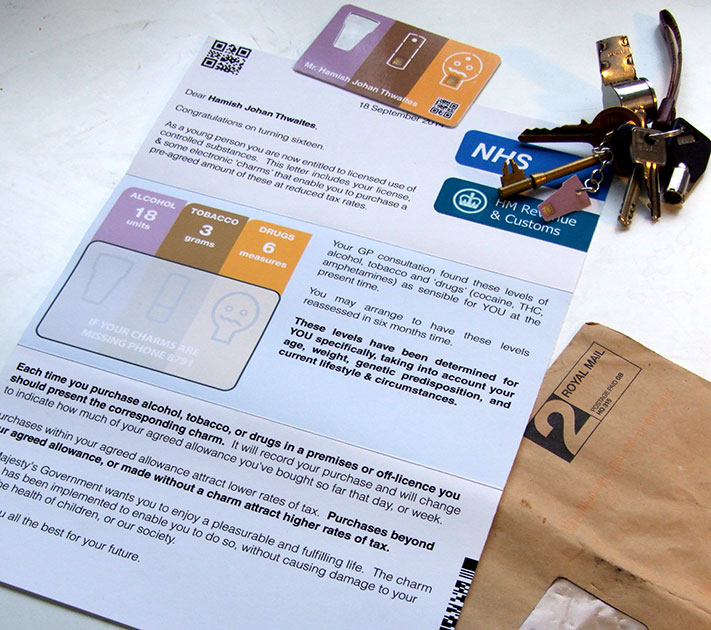
‘Dear Hamish Johan Thwaites,
Congratulations on turning sixteen.
As a young person you are now entitled to licensed use of controlled substances. Her Majesty’s Government understands these can be pleasurable, however they are dangerous and used in excess they cause damage to yourself, your family, your children (should you already/choose to have them), and our society. This letter includes your license to use these substances, & some electronic ‘charms’ that enable you to purchase a pre-agreed amount of these at reduced tax rates.
Your GP consultation found these levels of alcohol, tobacco and ‘drugs’ (cocaine, THC, amphetamines) as sensible for YOU at the present time. You may arrange to have these levels reassessed in six months time. These levels have been determined for YOU specifically, taking into account your age, weight, genetic predisposition, and current lifestyle & circumstances, and cannot be applied to other people.
Each time you purchase alcohol, tobacco, or drugs in a premises or off-licence you should present the corresponding charm. It will record your purchase and will display how much of your agreed allowance you’ve bought so far that day, or week. Purchases within your agreed allowance attract lower rates of tax. Purchases beyond your agreed allowance, or made without a charm attract higher rates of tax.
Her Majesty’s Government wants you to enjoy a pleasurable and fulfilling life. The charm system has been implemented to enable you to do so, without causing damage to your health, the health of children, or our society.
We wish you all the best for your future.’
This is an interesting idea, and actually feels less like the Nanny State than outright prohibition does.
After watching many of my friends and family struggle with addiction, I made a conscious choice to avoid addictive substances from a young age. I think this is a very reasonable system (though logistically difficult to implement). I am sure that young people would not be content with their assignments, and that the algorithms generated would bring controversy, but it makes a lot more sense to me than the “magic number” system. As an exceptionally mature young person who was always mistaken for being older, that system never meshed with my reality.
…Of course, I am from the States and we have a lot of other complications where that is concerned as well. (Like being able to serve and die for my country before being able to drink alcohol, for instance.)
Anyway, the idea is a sensible one. Thanks!
Brilliant! It is one the same level questioning, provocative, scary and a creative implementation of simple and sophisticated communication means.
keep up your creative mind!
all the best from germany&italy,
raphael
If you can’t even keep yourself from using ileagll drugs, what makes you so sure that you will follow the rules in other area’s?Marijuana and driving is still dangerous! Marijuana and working is still not safe! Overuse of marijuana may lead to death! Marijuana users will need therapy, and are prone to lung cancer. They will need money for radiation therapy, money that comes from insurance, that we need to pay.Why allow something that causes issues, and that forces innocent civilians to have to pay, because you want to mess up your body with drugs, and now we need to fix you again?GET REAL!!!
The point is that people will kill themselves through alcohol (legal), tobacco (currently legal), diet (sugar and fat are harmful and certainly kill more people than [insert statistic here]). So ignoring what happens to be illegal (and still used) or legal (and still used), a more sensible (and incidentally libertarian) view would be to try to and control a substance (any substance) in relationship to it’s damage to the individual and (hence) society. Anyway, I’m drunk delayed for hours in Basel airport! Think of my liver! hahaha